This guide explains general care options. Your history, examination and preferences determine an individual plan. It does not diagnose a condition or promise a treatment outcome.
A consultation can replace uncertainty with a plan
Trying for pregnancy can become emotionally demanding when each month brings another question. You may wonder whether to keep trying, repeat a test, change a medicine or ask about specialist care. You do not need to decide the entire treatment journey before a first consultation. A useful starting point is to explain how long you have been trying, what has already happened, and which uncertainty is making the next decision difficult.
At Gynaecare in Anand, a fertility consultation with Dr Priscilla is an opportunity to review that history and discuss appropriate assessment. This page explains the types of questions and investigations that may arise, not a promise of pregnancy or a claim that every fertility procedure is performed at the clinic. If more specialised care is appropriate, ask how a referral will work and what information should go with it. An informed next step can be valuable even before a treatment choice is made.
Fertility is not a test of personal worth
Difficulty conceiving can involve female factors, male factors, a combination, or an explanation that remains uncertain after initial testing. It should not automatically be treated as the woman's responsibility. WHO describes infertility as a reproductive health condition; it is not evidence that someone has failed at marriage, family life or healthy living. [1] A respectful consultation considers relevant information from both partners while recognising each person's privacy.
If you are attending with a partner, agree beforehand what questions each of you wants to ask. You can also request part of the consultation separately. Avoid making one person responsible for remembering every date, result and instruction. A shared folder or short joint checklist may reduce that burden. If relatives are involved in appointments or costs, discuss which information you want shared with them. Your decisions about treatment and disclosure should not disappear inside other people's expectations.
When to seek advice
General guidance recommends seeking assessment after a year of trying through regular unprotected intercourse, and sooner when age or a known concern makes waiting less appropriate. NHS guidance specifically advises earlier discussion for women aged 36 or over or when a fertility problem is already suspected. Your clinician can advise how this applies to your own history. [2] Do not use an arbitrary online deadline to delay help for an existing problem.
You can also request a planning conversation before trying, particularly if a medical condition, previous treatment or irregular periods raises questions. State clearly whether you want preconception advice, an initial fertility assessment or a review after treatment elsewhere. These are different starting points. Bring the date you stopped contraception if relevant, but do not feel that you must reconstruct every month perfectly. An approximate timeline is often enough to begin identifying which missing details are worth finding.
See the journey
An assessment that puts the pieces together
- Both historiesYour questions and earlier care
- Focused checksOvulation, sperm and other factors
- Shared decisionOptions, timing and practicalities
- Review or referralAgree the next milestone
Build a useful history rather than a large pile of reports
Write a short timeline of attempts to conceive, previous pregnancies, miscarriages, operations, significant illnesses and earlier fertility treatment. Include medicines and supplements used by both partners where relevant. If you have already had tests, bring the complete reports with their dates. For a previous treatment cycle, a note of what was prescribed, what monitoring occurred and what happened afterwards is more useful than only the name of the medicine.
The doctor may ask about periods, sexual difficulties, medical history and previous pregnancies as part of the assessment. [3] These questions can feel personal, so you can ask why a detail matters and how it will be used. Consider writing difficult information down if it is easier than saying it aloud. You should not need to prove that you have tried hard enough. The consultation is intended to understand the situation and decide which information is useful next.
What an initial assessment may consider
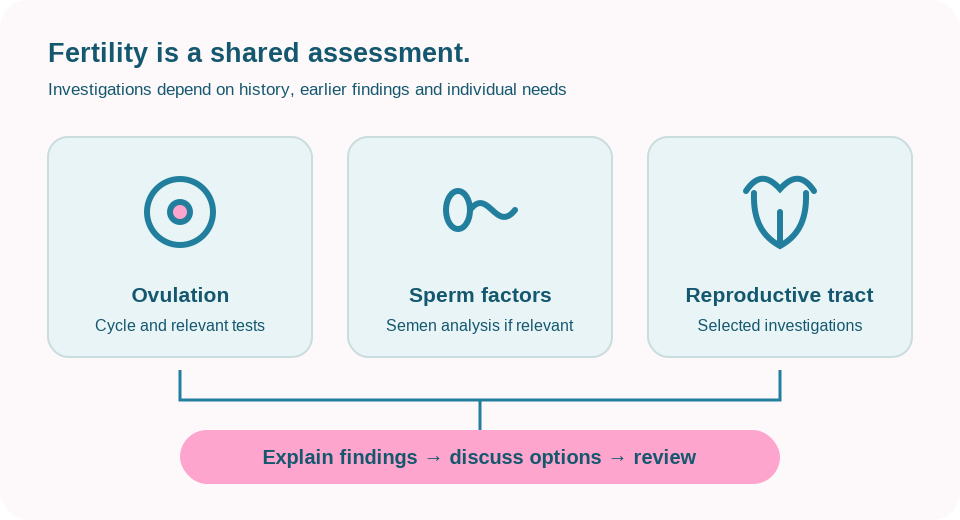
Assessment may involve understanding ovulation, reviewing the reproductive tract and considering semen analysis for a partner who provides sperm. The exact sequence depends on the history and earlier findings. A test should answer a clinical question rather than simply make the investigation list longer. Ask which question the proposed test addresses, whether it needs a particular cycle day, and whether a result from another laboratory can be used. [3]
You can ask for a written order of priorities: what needs doing now, what can wait for a result, and what may not be necessary at all. If the schedule is difficult because of work or travel, explain that before booking several investigations. Tests performed at the wrong time or without the required preparation may be harder to interpret. A practical plan should help you avoid unnecessary journeys while still allowing the clinician to obtain the information needed for safe decisions.
Interpreting results in context
A fertility report can contain many unfamiliar numbers, and it is easy for one flagged value to overshadow the rest of the discussion. Ask the doctor what the result actually measures and what it does not establish. One investigation cannot describe every aspect of a person's fertility or predict an individual outcome with certainty. A reassuring result may be useful without answering every question; an unexpected result may require confirmation or further explanation.
Bring the original report rather than a typed number or a screenshot with its date and units missing. Ask whether a repeat test would change the decision and, if so, why. If two clinicians have interpreted the same report differently, show the accompanying advice rather than deciding that one must be wrong. Your history, the timing of the test and the particular question being asked can affect interpretation. Before leaving, summarise your understanding aloud so that misunderstandings can be corrected.
Treatment choices are not a single ladder for everyone
Depending on the cause and individual circumstances, fertility care can include advice about timing, medicines, selected procedures or assisted conception. NHS patient guidance groups treatment into medicines, surgery and assisted conception options such as IUI and IVF. [4] Listing an option here does not mean that it is needed, suitable or available on site. Ask which choices are relevant to your findings and which would involve referral.
For any proposed treatment, discuss the aim, expected monitoring, important risks, practical demands and review point. Ask what the next decision would be if the plan does not achieve its aim. If you are comparing options, request an explanation that separates general success figures from estimates that may be relevant to your age and circumstances. A claim that a treatment guarantees pregnancy should not replace a careful discussion of uncertainty. You can take time to understand choices before committing to a new stage of care.
Do not self-prescribe a fertility plan
Products marketed for egg quality, hormone balance or conception can sound reassuring when you want something practical to do. Bring the labels or ingredient lists of anything you take, including herbal medicines and supplements. Tell the doctor about prescriptions from another clinic and medicines used by a partner. Fertility medicines may require monitoring and should not be started, repeated or combined simply because a previous prescription or online story seems similar to your situation.
If a plan has been difficult to follow, explain what happened accurately. Missing a visit because of work, not understanding an instruction or being unable to afford a test is information the clinician needs to make a realistic next plan. Avoid hiding a change because you worry it will be seen as failure. Ask which parts of the plan are time-sensitive, who can clarify instructions and what to do when an unexpected practical problem interferes with a scheduled step.
Make room for everyday life and emotional strain
Fertility concerns can make ordinary questions from family or friends feel intrusive. Before a consultation, think about what support would help and what boundaries you want. You might want a partner to manage appointment dates, a relative to stop asking for monthly updates, or time to talk privately about the effect on your relationship. The doctor can only respond to pressures that are made visible during the conversation.
It may help to agree periods when fertility research and discussion are put aside so that they do not occupy every evening. Consider whether counselling or another form of emotional support would be useful and ask where to find it. A treatment plan can be medically reasonable and still feel emotionally or practically unsustainable. You can raise that tension without making an immediate decision to continue or stop. Your preferences, limits and wellbeing are part of the decision, not an inconvenience outside it.
Discuss costs, travel and referral before they become surprises
Ask which parts of the assessment can take place through the clinic and which require an external laboratory, imaging centre or specialist service. Request clarification of what a quoted fee includes, whether follow-up is separate and when further costs might arise. Costs are legitimate questions to bring into the consultation. A plan that is not affordable or reachable cannot be followed simply because it sounds thorough on paper.
If referral is recommended, ask for a concise summary of the history, existing findings and the reason for specialist input. Keep copies of reports so that the next clinician can assess whether repeat tests are necessary. Ask who will coordinate ongoing general health care while specialist fertility treatment is considered. Do not assume that entering a referral pathway means every later decision is already made. Each stage should leave room to understand the options and choose the next step.
Follow-up and prognosis need individual discussion
There is no meaningful single prognosis for everyone reading a fertility page. Outlook depends on the findings, age, earlier history, the treatment considered and other individual factors. Ask the doctor to describe what is known, what remains uncertain and what additional information might change the recommendation. Be cautious about comparing yourself with another person's number of treatment cycles, even when the diagnosis sounds similar.
At follow-up, revisit the original goal and the agreed milestone. Ask whether the latest information supports continuing, changing the approach or seeking another opinion. If you need a pause, discuss how it might affect the plan and which health issues still need attention during that period. Good follow-up should explain a decision rather than automatically repeat the same step. Keep a short record of your questions and the advice you receive so that the next conversation can begin from a shared understanding.
Request a fertility consultation in Anand
Use the booking page to request an appointment with Dr Priscilla, and indicate whether this is your first fertility discussion or a review of previous assessment. Bring your timeline, medicines, earlier reports and the questions you most want answered. If a partner cannot attend, ask what information would still be helpful for the first visit and whether a later joint discussion is appropriate. The clinic reviews appointment requests before confirming them.
The immediate goal is clarity: understanding the relevant history, identifying useful investigations and agreeing a practical next step. You can ask questions about uncertainty, costs, privacy and referral as openly as questions about a laboratory result. For severe pain, fainting or bleeding with a possible or confirmed pregnancy, seek urgent medical assessment rather than waiting for a routine fertility consultation. A planned appointment and an urgent clinical concern need different routes to care.
Sources & further reading
General clinical information is informed by the sources below. Numbered references in the guide correspond to this list. Source links checked 24 October 2026. Local care arrangements are discussed with the clinic; UK service schedules and funding rules do not describe Indian clinic services.
- WHO: infertility
- NHS: when to seek fertility advice
- NHS: fertility investigations
- NHS: fertility treatment options
Bring any questions about this information to your consultation.
Your next step
Bring your questions.
We’ll start there.
Request a consultation with Dr Priscilla in Anand. Bring your medicines and earlier reports, and tell us what you want help understanding.
Find an appointmentContact the clinic